19 Nonparametric Identification of QTEs and DTEs in Simple RCTs
19.1 Introduction
Having set the stage, we now turn to identifying quantile and distributional treatment effects introduced in section 18.
We structure our discussion in two steps:
This section: we consider identification in a simple (pure) randomized control settings where the realized treatment \(X_i\) is fully independent from potential outcomes \(Y_i^x\).
The next two sections: we generalize the arguments to a setting with (conditional) unconfoundedness, where independence may hold only conditionally on some variables \(W_i\).
Our approach remains fully nonparametric: we impose no functional form restrictions on how potential outcomes depend on treatments or unobserved heterogeneity.
19.2 Setting
19.2.1 Assumption: Unconditional Unconfoundedness
In this section we consider the simplest setting in which the treatment \(X_i\) is marginally independent from the collection of potential outcomes indexed by treatment values \(x\): \[
\curl{Y^x_i}_{x} \independent X_i.
\tag{19.1}\]
There may potentially be some covariates \(W_i\), which are also marginally independent of \(X_i\): \[
W_i \independent X_i.
\tag{19.2}\]
This setting is represented by the single-world intervention graph on Figure 19.1, where the realized treatment node \(X_i\) is independent from the potential outcome \(Y_i^x\) (see chapter 7 of Hernan and Robins (2024) for a textbook introduction to single-world intervention graphs).
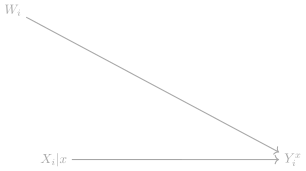
Intuitively, the setting of Equation 19.1 is a simple randomized controlled trial where the treatment is assigned independently of potential outcomes and other individual characteristics (unconditional unconfoundedness or a random effects setting, in panel data terminology).
As always, the realized outcome \(Y_i\) is equal to \(Y^x_i\) if \(X_i=x\) (i.e., we observe the potential outcome corresponding to the treatment actually received). The treatment \(X_i\) may be discrete- or continuous-valued. For continuous treatments, we assume standard regularity conditions (e.g., existence of densities) to ensure that conditioning on \(\curl{X_i=x}\) is well-defined.
19.2.2 Parameters of Interest
In the setting of Equation 19.1, interest lies in two kinds of QTEs and DTEs:
Unconditional QTE and DTE of Equation 18.1: \[ \begin{aligned} QTE(x_1, x_2, \tau ) & =Q_{Y^{x_2}}(\tau) - Q_{Y^{x_1}}(\tau) ,\\ DTE(x_1, x_2, y) & = F_{Y^{x_2}}(y) - F_{Y^{x_1}}(y). \end{aligned} \]
QTEs and DTEs conditional on some value of \(W_i\), defined in Equation 18.3: \[ \begin{align} QTE(x_1, x_2, \tau|w) & = Q_{Y^{x_2}|W}(\tau|w) - Q_{Y^{x_1}|W}(\tau|w), \\ DTE(x_1, x_2, y|w) & = F_{Y^{x_2}|W}(y|w) - F_{Y^{x_1}|W}(y|w). \end{align} \]
Observe that no new parameter is gained by conditioning on values of \(X_i\) — the independence restriction in Equation 19.1 implies that \[ F_{Y^{x_1}|X}(\cdot|x_1) = F_{Y^{x_1}}(\cdot) \] for any \((x_1, x_2)\). Hence the QTEs and DTEs of Equation 18.2 are equal to the unconditional QTEs and DTEs in Equation 18.1.
19.3 Identification
For all parameters of interest, it is sufficient to identify the quantile or distribution functions of the potential outcomes.
19.3.1 Unconditional CDF of Potential Outcomes
We begin with the CDF \(F_{Y^x}(\cdot)\) of \(Y^x_i\). To start, observe that we can use the independence assumption (19.1) to write \[ F_{Y^x}(y) \equiv \E\left[ \I\curl{Y^x_i\leq y} \right] = \E\left[ \I\curl{Y^x_i\leq y} |X_i=x \right]. \] Since \(Y^x_i\) is independent from \(X_i\), we may freely condition on event involving \(X_i\) without changing the expected value.
Next, under the event \(\curl{X_i=x}\) it holds that the realized outcome \(Y_i\) is exactly \(Y^x_i\), allowing us to conclude that \[ \E\left[ \I\curl{Y^x_i\leq y} |X_i=x \right]= \E\left[ \I\curl{Y_i\leq y}|X_i=x \right] \equiv F_{Y|X}(y|x), \] where \(F_{Y|X}(y|x)\) is the CDF of the realized outcome \(Y_i\) in the subpopulation of units with \(X_i=x\).
We conclude that, as long as there exist units with \(X_i=x\) in population, the marginal CDF of \(Y^x_i\) is identified as \[ F_{Y^x}(y) = F_{Y|X}(y|x). \]
19.3.2 Unconditional Quantile Function of Potential Outcomes
In order to identify the quantiles \(Q_{Y^x}(\tau)\) of potential outcomes, for each treatment value \(x\), we assume the CDF \(F_{Y^x}(\cdot)\) is continuous and strictly increasing. Then the quantile function \(Q_{Y^x}(\tau)\) is well-defined and uniquely characterized by the moment condition \[ P\left(Y^x_i\leq Q_{Y^x}(\tau) \right) = \tau \] or, in other words, that \[ \tau = \E\left[ \I\curl{Y^x_i\leq Q_{Y^x}(\tau)} \right] \]
We can now again apply the same conditioning argument to the above moment to conclude that \[ \E\left[ \I\curl{Y^x_i\leq Q_{Y^x}(\tau)} \right] = \E\left[\I\curl{Y^x_i\leq Q_{Y^x}(\tau) } |X_i=x \right]. \]
Finally, we can again use that \(Y^x_i=Y_i\) under \(X_i=x\) to connect the above moment to observed variables: \[ \E\left[\I\curl{Y^x_i\leq Q_{Y^x}(\tau) } |X_i=x \right] = \E\left[\I\curl{Y_i\leq Q_{Y^x}(\tau) } |X_i=x \right]. \]
Combining the two extreme of the above chain of equalities, we obtain that \(Q_{Y^x}(\tau)\) must satisfy the moment condition: \[ \tau = \E\left[\I\curl{Y_i\leq Q_{Y^x}(\tau) } |X_i=x \right] \] At the same time, under our continuity and strict monotonicity assumptions we know that \(Q_Y(\tau)\) (the \(\tau\)th quantile of the observed outcome \(Y_i\)) uniquely satisfies \[ \tau = \E\left[\I\curl{Y_i\leq Q_{Y}(\tau) } |X_i=x \right]. \]
We conclude that it must be the case that \[ Q_{Y^x}(\tau) = Q_{Y|X}(\tau|x). \] In other words, the \(\tau\)th quantile of \(Y^x_i\) is exactly the \(\tau\)th quantile of the observed outcome \(Y_i\) in the group with \(X_i=x\).
19.3.3 CDF and Quantiles Conditional on Covariates
Finally, we turn to identifying the conditional distribution function \(F_{Y^x|W}(y|w)\) and conditional quantile function \(Q_{Y^x|W}(\tau|w)\) that appear in the conditional QTE and DTE of Equation 18.3.
The argument for conditional CDFs and quantiles mirrors that of the unconditional case and again relies on the independence restriction (19.1), along with the independence condition (19.2). For example, the identification argument for the CDF looks as follows: \[ \begin{aligned} F_{Y^x|W}(y|w) & = \E\left[ \I\curl{Y^x_i\leq y}|W_i=w \right] \\ & = \E\left[ \I\curl{Y^x_i\leq y} |X_i=x, W_i=w \right]\\ & = \E\left[ \I\curl{Y_i\leq y}|X_i=x, W_i=w \right]\\ & = F_{Y|X, W}(y|x, w), \end{aligned} \] where \(F_{Y|X, W}(y|x, w)\) is the CDF of the realized outcome \(Y_i\) in the subpopulation of units with \(X_i=x\) and \(W_i=w\). As before, the group of units with \(X_i=x\) identifies the distribution of potential outcomes under \(x\). The argument for the quantiles of \(Y^x_i\) is entirely analogous, and leads to the identifying expression \[ Q_{Y^x|W}(\tau|w) = Q_{Y|X, W}(\tau|x, w). \]
Next Section
In the next section, we continue our discussion of identification and consider identification under the (conditional) unconfoundedness assumption that \(Y_i^x\independent X_i|W_i\).